Golden Retriever Puppy Feeding Schedule: Amounts by Age
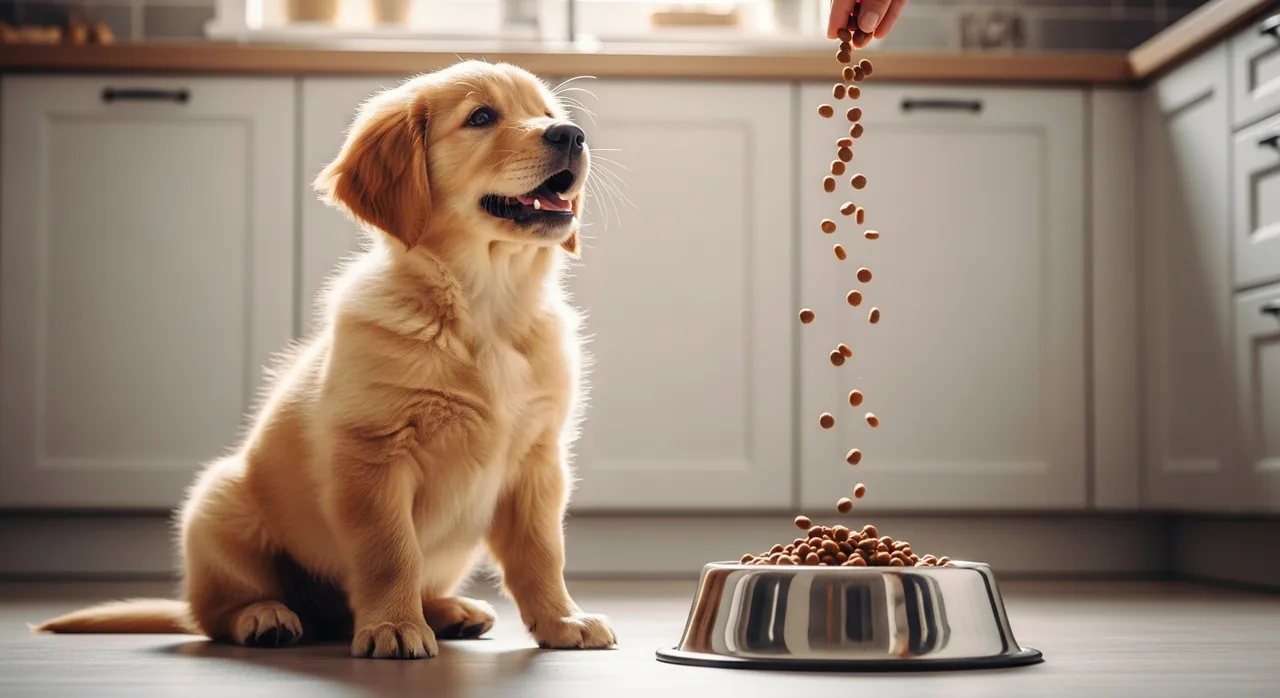
Ask ten golden owners how much they feed their puppy and you'll get ten different answers — because the honest answer is "it depends on the food, the puppy, and the month." What doesn't vary is the structure: golden puppies eat four meals a day at eight weeks, three by twelve to sixteen weeks, and two from six months onward, with portions that climb steadily and then plateau. Here's the whole system, chart first.
Feeding Chart by Age
These ranges assume a standard large-breed puppy kibble at roughly 350–400 kcal per cup. Your bag's feeding guide and your vet always outrank a chart on the internet — treat this as the starting point you adjust from.
| Age | Meals per day | Total food per day | Typical puppy weight |
|---|---|---|---|
| 8–10 weeks | 4 | 1.5 – 2 cups | 10 – 15 lbs |
| 10–12 weeks | 3–4 | 2 – 2.5 cups | 15 – 20 lbs |
| 3–4 months | 3 | 2.5 – 3 cups | 20 – 30 lbs |
| 4–6 months | 3 | 3 – 4 cups | 30 – 45 lbs |
| 6–9 months | 2 | 3.5 – 4.5 cups | 45 – 60 lbs |
| 9–12 months | 2 | 3.5 – 4.5 cups | 55 – 70 lbs |
| 12+ months | 2 | 3 – 4 cups (transition to adult food per your vet) | 55 – 75 lbs |
Notice that daily totals stop climbing around nine months even as the dog keeps filling out. That's by design — growth slows, and appetite shouldn't set the portions. Track your puppy against our golden retriever weight chart monthly and adjust a quarter cup at a time.
Why Large-Breed Puppy Formula Matters
This is the one non-negotiable in golden puppy nutrition. Large-breed puppy formulas deliver slightly fewer calories per cup and, critically, controlled calcium and phosphorus levels. Goldens grow fast, and skeletons pushed to grow at maximum speed — by excess calories or excess calcium — carry a higher risk of developmental joint problems in a breed already prone to hip and elbow dysplasia. Steady growth, not maximum growth, is the goal.
When choosing a bag, look for an AAFCO statement that says the food is formulated for "growth" or "all life stages" including growth of large-size dogs (70 lbs or more as an adult) — that parenthetical is the large-breed marker. The WSAVA global nutrition guidelines offer a solid framework for evaluating any brand's quality control and formulation credentials. For a deeper walk through labels, formulas, and the brands question, see our guide to the best food for golden retrievers.
Meal Frequency: 4 to 3 to 2
Small puppies have small stomachs and fast metabolisms, so meal frequency starts high and steps down:
- 8–12 weeks: four meals. Roughly 7 a.m., 11 a.m., 3 p.m., and 6:30 p.m. Keep the last meal early enough that the final potty trip precedes bedtime.
- 12 weeks–6 months: three meals. Drop the mid-morning meal and fold its portion into the others.
- 6 months on: two meals. Breakfast and dinner, which is the rhythm most goldens keep for life.
Scheduled meals beat free-feeding for three practical reasons: house-training runs on a predictable in-out schedule, appetite becomes a visible health signal, and a food-motivated golden with a set dinnertime is a dream to train.
Treats Within the Calorie Budget
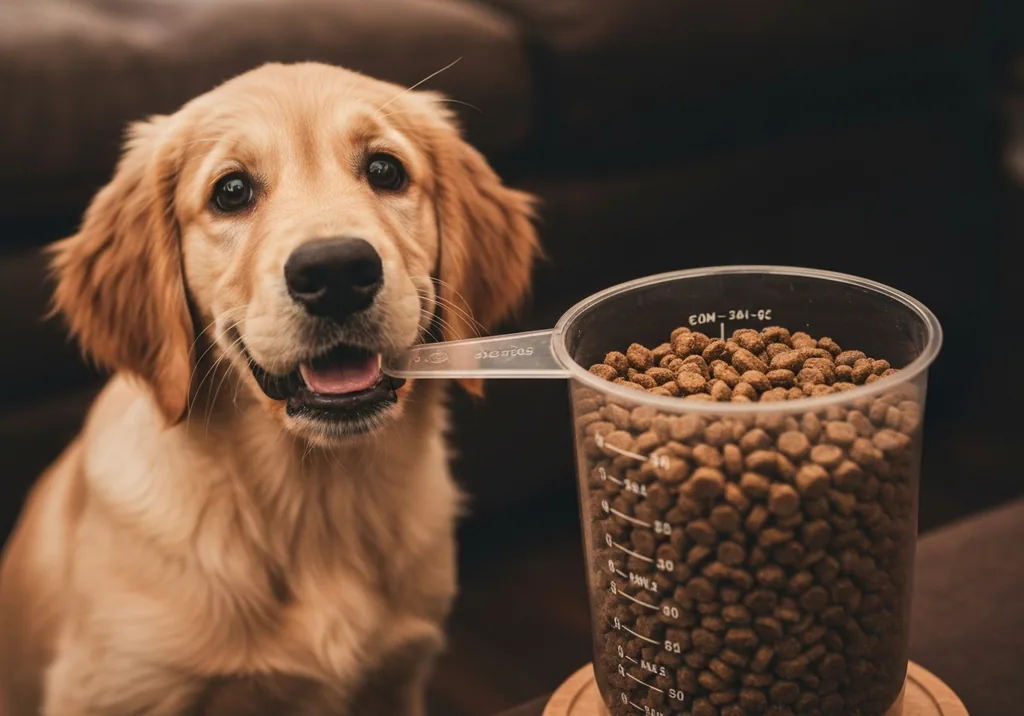
Golden puppies are in training constantly, which means treats are flowing constantly. Keep treats and chews at no more than 10% of daily calories, and make the budget easy to honor: use a portion of the day's measured kibble as training rewards, break commercial treats into pea-sized pieces (dogs value frequency far more than size), and count edible chews — they're calorie-dense and easy to forget. If a big training day blows the budget, trim dinner slightly.
Switching Foods Without Stomach Upset
Golden puppy stomachs object loudly to abrupt changes. Whether you're moving off the breeder's food or up to an adult formula, transition over about a week: days 1–2, 75% old food and 25% new; days 3–4, half and half; days 5–6, 25% old and 75% new; day 7, fully switched. If stools soften, hold at the current ratio for a couple of extra days before continuing. Bring the breeder's food home with you at pickup — day one of ownership, covered in our week-one playbook, is the wrong day to change diets.
Signs You're Over- or Under-Feeding
The bag feeds the average puppy; yours is a specific puppy. Read the dog, not just the cup:
- Just right: ribs are easily felt under a thin fat layer but not visible, there's a waist when viewed from above, and a tummy tuck from the side.
- Overfed: ribs take real pressure to find, no waist, sausage silhouette. In puppies this isn't cute — extra weight loads growing joints exactly when they're most vulnerable.
- Underfed: visible ribs, spine, or hip bones, prominent waist tuck, low energy, or obsessive food-seeking beyond normal golden enthusiasm.
Rule of thumb: you should always be able to feel ribs and see a waist — at every age. A lean golden puppy grows into a golden with healthier joints; a roly-poly one is adorable for six months and pays for it for twelve years. If weight is drifting either direction or appetite changes suddenly, that's a vet conversation, not a bigger or smaller scoop.
The Short Version
Large-breed puppy formula, measured meals on a 4-then-3-then-2 schedule, treats inside 10% of calories, week-long food transitions, and a monthly rib-and-waist check. That's the whole system. Everything past that — brands, toppers, supplements — is detail work you can settle with your vet at the next checkup, and the routine you build now carries straight through the rest of the first year.