Golden Retriever Exercise Needs: How Much Is Actually Enough?
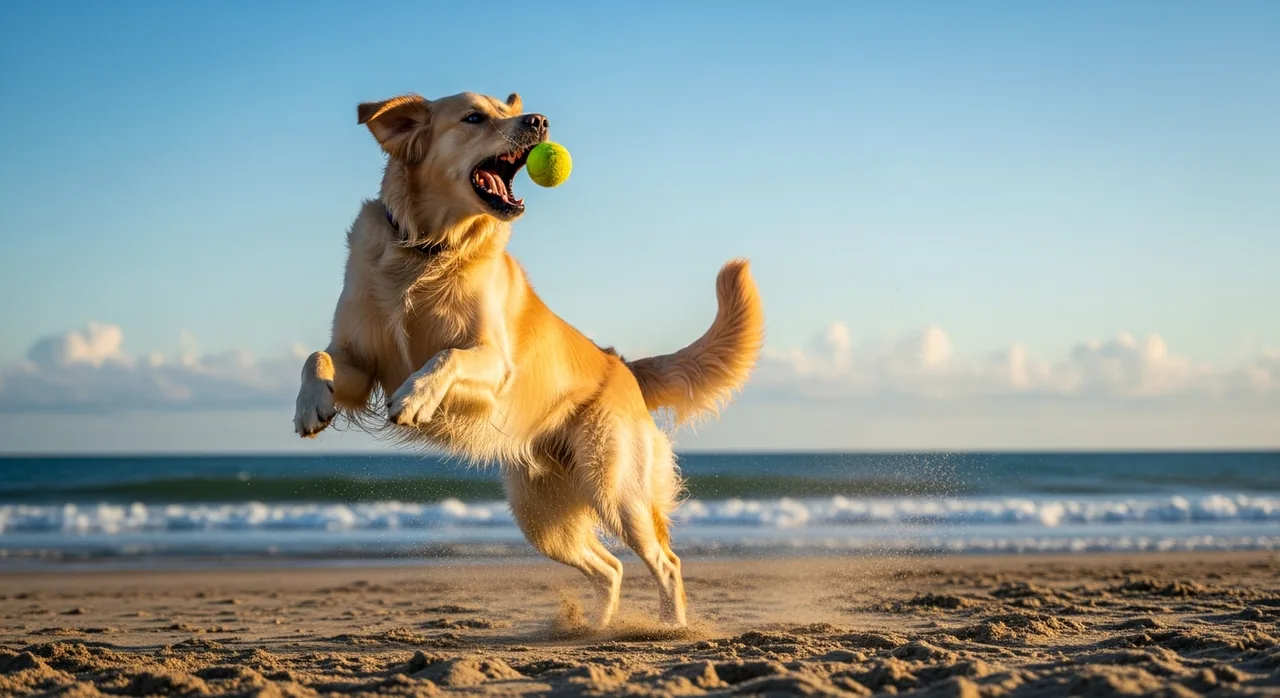
Ask ten golden owners how much exercise the breed needs and you'll get answers from "a walk around the block" to "two hours minimum or your furniture is firewood." The truth sits in the middle, and it changes dramatically with age: a routine that's barely enough for a two-year-old would injure a four-month-old puppy and exhaust a ten-year-old. Goldens were bred to work all day in the field, and that engine doesn't idle quietly — but the goal is the right dose, not the maximum one.
Daily Targets by Age
For puppies, the widely used rule of thumb is the 5-minute rule: about five minutes of structured exercise per month of age, up to twice a day. A four-month-old puppy gets roughly 20 minutes of leash walking per session — free play in the yard, where the puppy sets its own pace, doesn't count against the budget. Growing joints with open growth plates are the reason: goldens are a dysplasia-prone breed, and repetitive forced exercise before the skeleton matures (around 12–18 months) adds risk you can simply avoid by waiting.
| Age | Daily structured exercise | Notes |
|---|---|---|
| 2–4 months | 10–20 min, split into 2 sessions | 5-minute rule; free play extra; no stairs marathons |
| 4–8 months | 20–40 min, split sessions | Leash walks, short sniffy outings, foundation training |
| 8–18 months | 40–60 min | Still no forced running or repetitive jumping until growth plates close |
| 18 months–7 years | 60–120 min | Walks, swimming, hikes, fetch in moderation, training games |
| 7–10 years | 45–60 min, lower intensity | Two moderate walks beat one hard session |
| 10+ years | 20–45 min, gentle | Short frequent outings, swimming if available; follow the dog |
These ranges align with general AKC exercise guidance for sporting breeds, but individual dogs vary — field-line goldens often need the top of each range, and any dog with joint or heart issues needs a plan from your veterinarian, not a chart.
Physical vs Mental Exercise
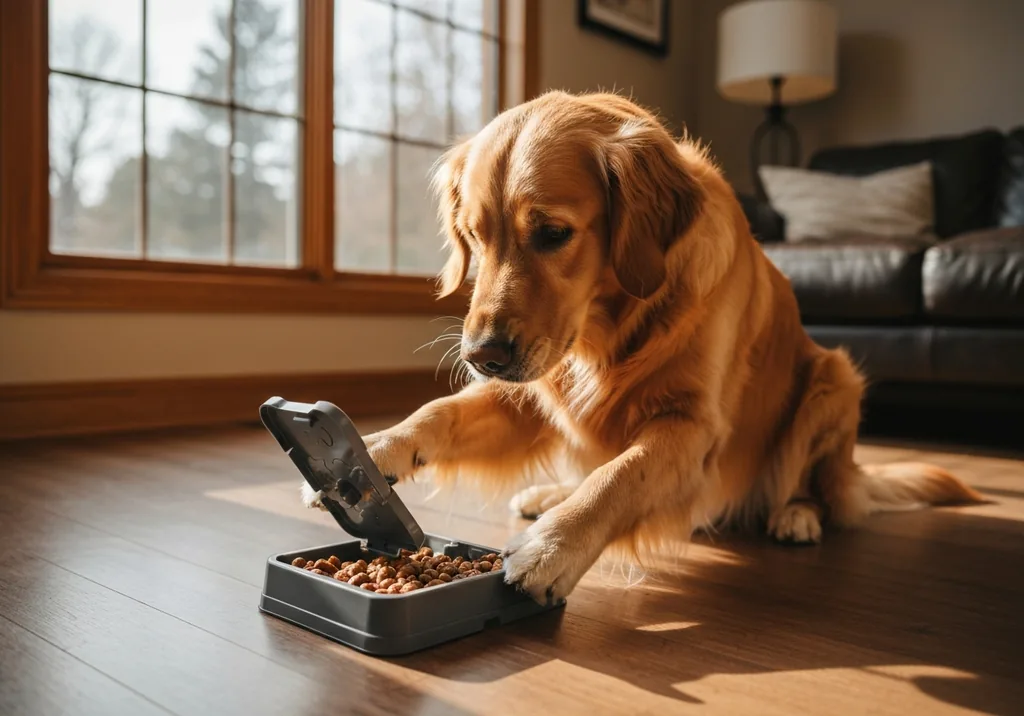
Here's the secret experienced golden owners eventually learn: twenty minutes of brain work tires a golden more than an hour of trotting. These are dogs bred to solve problems in the field — mark a fall, hold a line, work with a handler — and problem-solving is metabolically expensive for them. A "sniffari" walk where the dog chooses the route and reads every fire hydrant, a ten-minute training session on a new skill, a puzzle feeder at dinner, or a game of find-the-treat around the house all count toward the daily budget.
A practical split for an adult: roughly two-thirds physical, one-third mental. On rainy days or during heat waves, flip the ratio and you'll still get a settled dog. If your golden gets miles but no mental work and is still restless at 9 p.m., the missing ingredient is almost never more miles. Puppies especially benefit from this balance — our first-year puppy guide covers age-appropriate brain games month by month.
Swimming: The Perfect Golden Workout
If you have access to safe water, you have the breed's ideal exercise. Swimming is high-effort and zero-impact — full cardiovascular work with none of the joint loading of running on pavement, which makes it the best option for growing adolescents, overweight dogs working back to condition, and seniors with arthritis. Most goldens take to water instinctively (it's in the name), but introduce puppies gradually, rinse the coat after chlorine or lake water, and dry ears thoroughly afterward — goldens' floppy ears plus trapped moisture is the classic recipe for ear infections.
Fetch Addiction and Joint Stress
Fetch is the golden's drug of choice, and like most drugs, the dose makes the poison. A golden will retrieve until it injures itself — the breed has essentially no self-limiting instinct with a ball in play. The problem is the movement pattern: repeated all-out sprints, hard braking, and twisting leaps, dozens of times in a row, load exactly the joints (hips, elbows, knees) where the breed is weakest.
Keep fetch, but manage it: sets of five to ten throws with breaks, low throws rather than high pop-flies that trigger leaping catches, grass instead of pavement, and no marathon sessions for adolescents whose growth plates are still open. Mixing in "find it" throws into long grass converts a sprint game into a slower scent game the dog enjoys just as much.
Heat warning: a double-coated breed doing high-drive exercise in summer is a heatstroke risk. Above roughly 80°F (27°C), shift exercise to early morning or evening, choose swimming or shaded sniff-walks over fetch, carry water, and watch for heavy panting with a wide, spatula-shaped tongue, wobbling, or sudden slowing. Heatstroke is an emergency — if you suspect it, cool the dog with water and get to a veterinarian immediately.
Weather Limits: Heat, Cold & the Double Coat
The same coat that makes summer risky makes winter easy — most goldens are delighted in snow and safe in cold well below freezing for normal activity. The two winter cautions are ice (slipping injuries) and road salt on paws. In summer, remember pavement temperature: asphalt in the sun can be 40 degrees hotter than the air. If the back of your hand can't rest on it for seven seconds, walk on grass or wait. And never shave the coat for summer — it insulates against heat too, a point we cover in our shedding guide.
Signs of Under- and Over-Exercise
Your dog will tell you whether the current routine is right:
- Under-exercised: destructive chewing, counter-surfing, digging, barking at nothing, pacing in the evening, pulling like a freight train on every walk, "the zoomies" indoors at 10 p.m. This is the most common cause of "behavior problems" in young goldens.
- Over-exercised: stiffness or limping after rest, reluctance to jump into the car, lagging on walks the dog used to love, paw-pad wear, or a puppy that collapses into abnormally deep sleep and wakes up sore. Persistent stiffness or any limp lasting more than a day or two warrants a vet visit — in this breed, don't wait it out.
Exercise is also half of the weight equation: a golden at a lean body condition, moving an hour a day, is stacking the odds on the two factors owners most control for a long life. See where your dog should sit on our weight chart, and why lean matters so much in our golden retriever lifespan guide.
The Bottom Line
An hour or two a day for a healthy adult, scaled down sharply for puppies and seniors, with a third of it working the brain instead of the legs. Protect growing joints, ration the fetch, respect the heat, and adjust to the dog in front of you — with your vet's input whenever health enters the picture.